
How Copy Shrinks and Empowers Women
Words by Molly Isaac
For women, the dictionary hasn’t always been on our side.
Women are often infantilised through everyday language: “good girl,” “smile more,” “don’t be emotional.” Even our relationship status becomes an identity. Spinster versus bachelor. Miss, Ms, and Mrs titles, while men remain Mr. for life.
We are “bossy” where men are assertive. “Emotional” where men are passionate. “Hysterical” where men are decisive. A woman who is direct risks being labelled difficult, dramatic, or a Karen. A man doing the same is simply confident.
These words are not incidental or insignificant, as language does more than describe the world. Its power lies in shaping how we understand and value everything within it. It shapes how women are heard, promoted, and remembered.
In the past, copy didn’t just mirror these expectations, it normalised them. It sold them. And turned social limits into brand voice.
A short history of limiting language
For decades, advertising and brand copy amplified these limits. It packaged narrow expectations into slogans, campaigns, and product descriptions that defined what womanhood was allowed to look like.
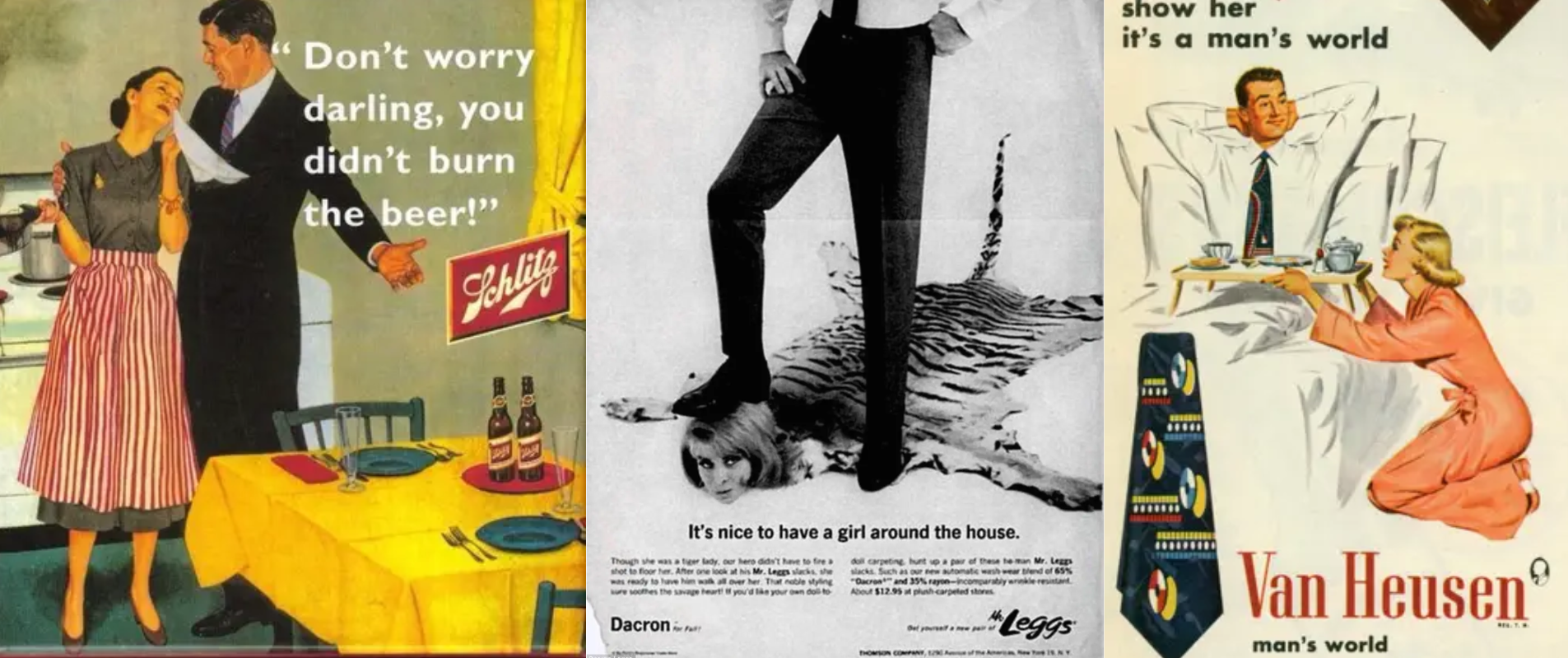
From the 1950s until the 1980s, advertisements routinely depicted women as domestic, dependent, and intellectually secondary.
Cleaning ads joked about wives burning dinner. Appliance campaigns reassured husbands that their purchase would keep their wives “happy.” Many ads went further still, visually placing women beneath men, reinforcing the idea that their role was to serve or please them.
While advertising didn’t invent gendered language, it industrialised it.
How female-led brands are rewriting womanhood through language
Today, more women are building the brands. Writing the copy. Setting the tone. Choosing the words.
Because copywriting can do so much more than sell products.
These female-founded brands are rewriting the language around women’s bodies and lives, making space for women to own them openly (not that we should ever need permission).
⭐️ 1. Biolae
Menopause has long been marketed as something to conceal, soften, or endure quietly.
For decades, the language surrounding it has leaned toward euphemism and apology, framing a natural stage of life as something women should manage discreetly rather than understand openly.
Biolae rejects that framing entirely.
Founded by Maryalice R. and Briella Brown, the brand develops targeted supplements for menopause-related symptoms, vaginal health, and body composition.
Their messaging refuses to treat women as fragile consumers in need of reassurance. After all, we’re the ones living these experiences and the last people the truth needs to be hidden from.
“We built Biolae so women could finally feel seen in a system that overlooked them — by replacing stigma and low standards with modern science, clarity, and better tools for midlife.”
Across the brand’s website and educational resources, menopause is discussed with scientific clarity and directness. Symptoms are named and explained without condescension.
“Hot flushes. Sleepless nights. Brain fog mid-sentence. Bodies changing in unfamiliar ways. And when women ask for help, they're told it's ‘just aging,’ ‘just stress,’ or worse: ‘normal.’
But perimenopause isn't an inconvenience. It's biology. And it deserves the same scientific rigour as every other stage of health.”
The brand has built an extensive educational hub dedicated to helping women understand their bodies, covering everything from essential menopause guides to practical topics such as “What Helps with Vaginal Dryness?”. Nothing is softened or avoided. And, this kind of knowledge itself can be incredibly empowering.
In an area that has often patronised women with apologetic language, Biolae speaks loudly and proudly.
Because ultimately, as Biolae reminds its audience, “Women are forces of nature.”
⭐️ 2. Kin Fertility
Kin Fertility is transforming one of the most emotionally charged and historically dismissed areas of womanhood: reproductive health.
Founded by Nicole Liu, the brand develops pre- and post-natal supplements, with messaging that confronts the silence that has long surrounded fertility, pregnancy, miscarriage, and postpartum recovery.
As the brand explains, many of these experiences remain difficult to talk about, leaving women isolated in moments that are, in reality, deeply common.
“Issues surrounding fertility, contraception, pregnancy complications, and postpartum recovery can be uncomfortable to talk about…
There remains a sizeable gap in the understanding of what we know about our own bodies. For that reason, products and services, especially in the maternal health space, haven’t evolved with us and for us. That’s when we knew we had to take action.”
Rather than softening these realities, Kin advocates for more attention. Their writing names cycles, hormones, uncertainty, and loss without secrecy or sugar-coating. Blog titles such as “7 ways your vagina can change after birth” illustrate a tone that is clear, practical, and unashamedly honest. Women deserve language that reflects their experiences, not erasing them.
The brand’s philosophy is explicit:
“Women-centred, women-led healthcare… putting you in the driver’s seat of your health journey.”
At Starr Studio, we’ve supported Kin Fertility through its #WeNeedMoreLeave campaign, where the company advocated for at least ten days of paid miscarriage leave, using research and public advocacy to challenge workplace policies minimising pregnancy loss.
Kin rewrites fertility from something whispered about to something women can openly understand, discuss, and advocate for.
⭐️ 3. Modibodi
For decades, periods were disguised in advertising. They were renamed, sanitised, and hidden.
ICYMI: Modibodi takes the opposite approach.
The brand creates reusable underwear, swimwear, and teen ranges designed to absorb periods, leaks, and discharge without disposable products. Each garment is rigorously tested for absorbency and breathability, designed to remain leak-proof for up to 100 washes, and certified free from harmful substances.
Founder Kristy Chong was training for a marathon when she experienced bladder leaks while running and realised the only solutions available were disposable hygiene products that were uncomfortable, unreliable, and wasteful.
Modibodi's voice is honest and functional, with no effort to disguise the realities of menstruation. Why should something so ordinary, which happens every month for millions of women, carry so much stigma? Bodily processes are treated as biological realities, not flaws.
Personally, I often think about how helpful something like this would have been when I was a teenager. Periods can feel so overwhelming at first. Pads, tampons, worrying about leaks, especially when trying to sleep. Seeing them spoken about so openly would have made it feel far less embarrassing.
By removing shame from the vocabulary, Modibodi helps women see their periods differently, not as something to apologise for, but as a reminder of just how incredible their bodies are.
Why language matters
Brands today are empowering women. They are using language that women can recognise, adopt, and use to speak about themselves with confidence.
We have come a long way from the advertising tropes of the 1950s, when copy shrank women into narrow roles and polite expectations.
Copy plays such an important role in shaping the social narratives of our world. The words brands choose today help teach younger girls to treat their bodies with kindness and to feel proud of who they are and what they experience.
Working in copywriting at Starr Studio, I hope this signals the beginning of more brands using their platforms to advocate for women.