
Not all content agencies are created equal: Here's what to look for
Words by Lucinda Starr
So, you need a hand with content marketing.
Maybe your team has been managing it in-house. Maybe it’s been at the bottom of your to-do list for longer than you’d care to admit (I get it, founder life is hectic). Maybe you’ve thrown a few things at the wall, but nothing seems to stick.
A quick Google search reveals a sea of content marketing agencies across Australia. Reading reviews is a good starting point, but how can you really figure out who the right fit is?
IMO: Choosing a content agency is one of the most important decisions you’ll make for your brand. You need a team of tastemakers who understand how the platforms work, what your audience cares about, and how to craft the right messaging to reach them.
And just quietly? Content is one of your most impactful growth levers. So, it’s worth getting this right.
The difference between a content partner and a content factory
Content has often been seen as a numbers game. Post every day, if not multiple times a day. Send more emails. Publish more blogs. Have you tried TikTok? What about LinkedIn? How about a podcast?
It comes from a good place. More content should equal greater visibility, right? Unfortunately, volume isn’t the metric that matters here.
Broadly speaking, content marketing agencies fall into two buckets. The first prioritises speed and scale of production (content factories), while the second focuses on authority, originality and depth (content partners). This distinction is important: it’s what separates content for content’s sake from content that pulls its weight.
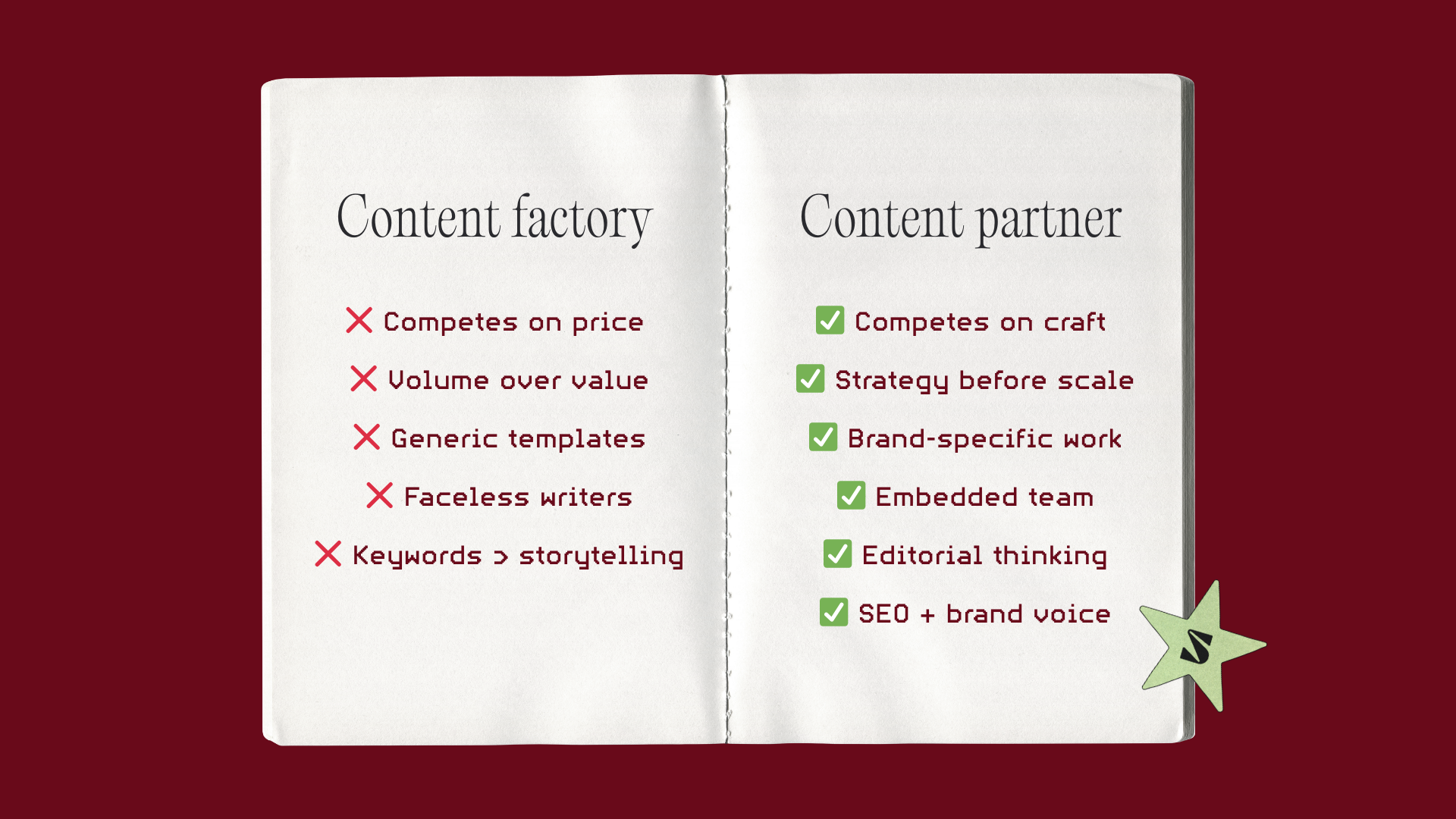
It’s easy to be tempted by the appeal of content factories. I’ve seen figures like “$4 an hour” and “1c per word” thrown around, promising to give you access to the “top 1% of content writers worldwide” for prices that feel too good to be true. It feels like a race to the bottom, right?
Unfortunately, I’ve seen the output of these companies firsthand. On more than one occasion, my team and I have been brought in to edit content written at bargain basement prices. What begins as a “light editing job” quickly evolves into complete rewrites, costing our clients valuable time and budget, too.
The best content agencies won’t be focused on discounts and pushing for bulk production from day one. They’ll be curious about your brand’s voice and how you’re positioned against competitors. They’ll be asking about your customers and what motivates them to pay attention. And, most importantly, they’ll be keen to develop a strategy (one that blends editorial thinking with SEO best practice) before posting cadence and blog topics enter the chat.
Green flags to look for in a content marketing agency
So, what does “good” look like when comparing content marketing agencies? I’m not going to go into the usual stuff like reading their reviews, looking for case studies, and making sure they can do the services you’re looking for (I know you’ve got the basic due diligence covered).
Without knowing your business specifically (trust me, I wish I had a crystal ball), here are a few signs you’ve found a content team worth talking to:
They lead with editorial judgment, not just SEO metrics: Technical SEO matters, but obsessing over keyword density while ignoring storytelling is how you end up with content that ranks and converts nobody. You want an agency that understands brand voice, has taste, and thinks about your whole content ecosystem, not just blog posts, but how your brand shows up across newsletters, LinkedIn, podcasts, maybe even print.
They have a clear (and honest) stance on AI: What matters is not whether they use AI, but whether they're transparent about it. Good agencies will tell you exactly where AI fits (research, first drafts, ideation) and where it doesn't (final copy, brand voice, anything compliance-heavy). If they're weirdly vague or defensive when you ask, that's usually telling.
You can see exactly who's working on your account: Many agencies hide behind "our team of experts." You want to see actual humans (their writers, strategists, editors and creatives), ideally with faces, names, and POVs visible on the website and LinkedIn. If they're proud of their team, they'll show them. If everyone's anonymous, ask why.
Strategy comes before the first word gets written: If an agency wants to start cranking out blogs before they've nailed your brand voice, positioning, and content pillars, you're likely talking to a content mill, not a content partner. You need a team that asks uncomfortable questions in discovery, not one that nods along and starts writing.
Their own content doesn't bore you to tears: Is their founder active on LinkedIn or Substack? Do they publish thought leadership that's actually interesting? Are their socials visibly different from every other agency? If they're not investing in their own content, why would they care about yours?
The agency red flags you don’t want to ignore
On the flip side, there are a few warning signs that are worth paying attention to. The points below aren’t necessarily deal breakers. But these agency red flags can help you validate that gut feeling after a discovery call that just feels “a bit off”:
They lead with cheap pricing as their main drawcard: As they say, you get what you pay for. Agencies competing on volume and discounts are possibly (ahem, probably) outsourcing to inexperienced teams or churning through writers faster than you can say "brand voice." If the pricing feels suspiciously low, it's probably because you're paying for words, not thinking.
Zero mention of strategy or brand voice development: If their pitch deck is all about deliverables ("50 blogs a month!" "Daily social posts!") with no talk of positioning, messaging frameworks, or voice guidelines, they're likelya production line. And production without strategy is just noise.
Faceless agency with a rotating cast of writers: You can see the CEO on the website, maybe a few senior strategists, but no insight into who's actually writing your content. Great content comes from writers who are deeply embedded in your brand, not a revolving door of contractors who don't know your customers from a bar of soap.
Their own content is generic, corporate, or overly aggressive: If their blog is full of AI-generated slop or their homepage copy could belong to any agency, they're not prioritising content for themselves. Bonus red flag: agencies that spend all their time trash-talking competitors instead of showing what makes them different.
They're pushy with urgency tactics and freebies: "Book now!" "Limited spots available!" "Normally $4,000, but yours today for $0!" If they're using high-pressure sales tactics to get you to sign, imagine what the client experience will feel like. Good agencies don't need to manufacture urgency; their work speaks for itself.
And a final thought to keep in mind: Award-winning agencies don't need to tell you they're award-winning in every second sentence.
Questions worth asking before you sign anything
Jumping on a discovery call with a content agency? Fab, I’m so excited for you! If you need a steer with what to ask, here are a few places to start:
Question 1. What's your stance on AI-generated content?
This one is a transparency test. Every agency is (and should be!) using AI; the key is knowing how and when to bring it into the process.
Ideally, you want the team to have a clearly articulated view on how AI can support with research, structuring, and the operational side of bringing content to life.
What you don't want to hear is defensiveness, vagueness, or the phrase "we have proprietary AI tools" without any explanation of what that actually means. If they can't articulate a philosophy on when to use AI and when to avoid it, they probably haven't thought about it deeply enough.
Question 2. What brands do you think are setting the bar for content right now, and why?
This is the taste test. An agency worth working with should be able to rattle off three brands whose content makes them jealous, and articulate exactly why it's working.
Do they geek out over storytelling, brand voice, creative risk-taking? Or do they just name whoever has the biggest ad budget? The best content agencies obsess over other brands, have strong opinions about recent campaigns and are inspired by work from a wide range of industries.
Question 3. What's a piece of content or project you've delivered recently that you're actually proud of, and why?
You’re looking for passion here. Not the flashy project for a hallmark brand, but the project that makes their eyes light up.
Listen for what they focus on: Is it just the outcome (traffic up 200%!), or do they talk about the process: the creative problem they solved, the brief that almost broke them, the moment they nailed a tone of voice that had been eluding the client for months? Good agencies care about the craft, not just the metrics. And if they can't think of anything they're proud of in the last six months, that tells you everything you need to know about how much they actually care about the work.
Question 4. What are your first thoughts on our brand's content strategy?
This is the question that reveals how much homework they've done. You're not expecting a fully-baked strategy on a first call, but you should see evidence that they've poked around your website, read a few blog posts, maybe checked out your social presence or competitors.
The best agencies will also ask questions before they give opinions: Who's writing your content now? What's working that you want more of? What are you secretly embarrassed by? If they're already pitching solutions before they understand the problem, that's a red flag.
But if they're curious, observant, and unafraid to point out gaps? That's someone who's actually interested in making your content better, not just selling you a retainer.
If you're looking for an agency that leads with editorial thinking and stays curious about your brand, we'd love to hear from you.